

Dual-Output Single-Housing In-Ground Landscape Lighting
Nov 03, 2026
Architectural site lighting frequently demands varying illuminance levels across adjacent landscape features while requiring visual uniformity in luminaire dimensions during daylight hours. Dual-output single-housing architecture resolves this design requirement by offering two distinct lumen outputs within an identical mechanical shell and installation cut-out footprint. Positioned in the mid-power to high-power tiers of subterranean landscape luminaires, this architecture utilizes standardized die-cast aluminium bodies paired with high-transmittance tempered glass covers. Product families applying this structural framework span both symmetrical narrow-beam accent projectors and wide-asymmetric wall washers. Housing bodies maintain identical external dimensions regardless of internal driver wattage or optical distribution, enabling uniform mechanical integration across varied landscape zones.
One Housing, Two Output Packages
Luminaires such as models BE-WUL0603 and BE-WUL0803 utilize a standardized die-cast body structure, identical outer trim dimensions, and identical mounting sleeve cut-outs. One variant operates at a lower wattage for accent lighting under lower palm canopy heights or along pedestrian path edges, while the second variant delivers higher wattage and lumen output to illuminate tall architectural columns or mature tree foliage. Internal component layouts position higher-output LED arrays on thermal sub-mounts that align directly with outer housing thermal paths, maintaining physical symmetry across both output configurations while preserving the structural footprint.

On-site effect display of high-power inground tree uplighting in a coastal commercial property plaza landscape project
On complex commercial or hospitality sites, landscape features vary in scale, ranging from single-story perimeter walls and low ornamental palms to multi-story architectural columns and mature specimen trees. Variable physical fixture sizes across a single installation create visual clutter during daylight hours, as different trim diameters break the continuous geometry of stone paving or lawn edges. Dual-output single-housing architecture maintains identical surface trim dimensions across the site while delivering tailored lumen output to each specific feature. Alignment along linear pathways remains visually coherent because top trim rings share identical outer edge boundaries and surface projection profiles.
Thermal Behavior Across Output Tiers
Thermal behavior in single-housing dual-output configurations varies based on drive current and internal power dissipation. Operating at the higher wattage setting increases thermal energy generation at the diode junction, driving heat outward through the printed circuit board into the die-cast body wall. Die-cast aluminium features high thermal conductivity, conducting heat away from internal driver circuits into the surrounding mounting sleeve and damp sub-grade soil. Lower-wattage variants operate at lower junction temperatures, allowing excess thermal capacity in the shared aluminium housing shell to dissipate heat rapidly. The physical mass of the unified housing body acts as a subterranean heat sink, preventing localized thermal saturation during continuous nighttime operation.
Environmental variations such as ambient ground temperature shifts alter thermal dissipation dynamics across subterranean lighting installations. In warm climate regions where ambient ground temperatures remain elevated, heat transfer from metal housings into surrounding soil slows down. The generous surface area of the unified housing body compensates for reduced thermal gradients, transferring heat across its outer perimeter without exceeding maximum junction operating limits. When site conditions involve wet or saturated backfill, soil thermal conductivity increases, facilitating rapid heat extraction from the metal housing body into the surrounding earth.
Site Power and Optical Behavior
Subterranean electrical distribution across extended commercial property perimeters introduces line voltage drop along long circuit runs. Connected luminaires located farther from central power feeds experience reduced supply voltage compared to units positioned near the power source. Integrated constant-current drivers operating inside dual-output single-housing luminaires regulate current delivery to the LED array despite input line fluctuations. Driver circuitry maintains steady current output across varied line distances, preventing visible lumen drop between fixtures installed near the control panel and fixtures located at remote circuit terminations.
Optical behavior adapts to varying viewing distances and mounting heights across architectural site layouts. High architectural columns viewed from distance require concentrated, high-lumen directional beams to illuminate upper stone surfaces without spreading excess light into adjacent open areas. Low pathway lighting viewed from close pedestrian proximity requires controlled surface luminance to prevent glare into eyes. Pairing high-wattage driver configurations with narrow spot optics inside tall column luminaires, and lower-wattage driver configurations with diffuse wide lenses in pathway luminaires, allows dual-output single-housing systems to control glare while matching photometric intensity to viewing distances.
Standardized Cut-Outs and Civil Work
A single physical body size maintained across multiple output tiers standardizes on-site civil works. Core drilling diameters, concrete embedding sleeves, and paving cut-outs remain uniform across the entire site layout. Contractor inventory and spare parts logistics simplify down to a single replacement body size per project, reducing maintenance complexity over the operational lifecycle of the property. Standardized core drilling sizes allow civil contractors to execute ground preparation using one core bit diameter across all in-ground fixture locations. Uniform mounting sleeves slide into concrete pours or stone paving beds before specific fixture wattages are assigned to individual circuit lines, accelerating construction schedules and reducing installation errors.
Alternative fixture architectures utilizing different physical body sizes for each wattage tier require multiple core bit sizes, variable sleeve embedding depths, and complex installation layouts on site. Variable trim diameters create uneven gaps along paved walkways and force custom cutting of natural stone or concrete pavers around larger fixtures. Dual-output single-housing construction eliminates these structural complications by confining all power variations within a unified mechanical shell, preserving structural integrity in surrounding stone paving and maintaining continuous linear layout aesthetics.
1–10 V Dimming and Outdoor Hazards
Advanced output management incorporates 1–10 V dimming capability directly within the internal constant-current driver. Connected to a centralized control system or automated timer relay, dual-output luminaires drop output levels after midnight. A higher output setting during early evening peak hours steps down for late-night hours. This dimming function reduces site energy consumption and chip operating temperatures without requiring a secondary power circuit or secondary fixture line. Reduced diode operating temperatures during late-night hours reduce thermal expansion stress on silicone seals and internal electronic components, supporting long-term structural reliability.
Subterranean environmental hazards, including temporary water submersion during heavy rainfall and ground soil salinity in coastal commercial property sites, place heavy demands on housing sealing systems. High-temperature silicone seals and IP67 ingress protection maintain internal dry conditions during ground thermal cycling. When cold surface rainwater strikes hot cover glass, internal air contracts, creating negative pressure inside the sealed cavity. High-density silicone gaskets maintain elasticity under mechanical compression, preventing ambient moisture from breaching body joints. Cable entry points utilize resin-filled glands and potted wire transitions to block capillary water wicking through power cables, preventing moisture penetration into driver electronics during extended periods of ground water saturation.
Related In-Ground Lights
TL-DMD-G06F4 In-ground Light 18 W / 24 W IP67 RGBW
TL-DMD-D18F2 RGBW Linear In-ground Light 18-48 W IP67
TL-DMD-D1801 Polarized Linear In-ground Light 18-48 W IP67
For dual-output in-ground lights specification files, photometric data or a project quotation, send your site layout and mounting details through Contact Us.
Background on how we build and test exterior luminaires: About Us.
This guide on dual-output in-ground lights was updated in October 2026 for commercial and hospitality exterior projects.
You Might Also Like
-

BL-BO25010-320 Bollard Light 320 mm 10 W IP65 Aluminum
-
55218 Recessed Wall Light 9 W IP65 Die-Cast Aluminum
-

5x11 mm Front Emitting LED Neon Flex GM-D2835Y-120-X-IPX ...
-

LAT27350007 Surface Mounted Wall Light 5 W IP65 Aluminum
-
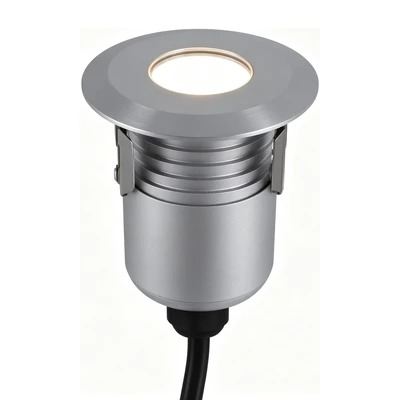
BE-WUL0103 In-ground Light 1 W IP67 Aluminium
-
TL-TSD-G2403 Up-and-Down And Single-Direction Cylinder Wa...