

Fogging Is Not a Leak: Where Water Actually Gets Into Outdoor LED Lighting
Sep 12, 2026
Field failure analysis across the lighting industry keeps finding the same thing: the luminaire body is rarely the point of failure. The failure happens at the connection point, where the fixture pigtail meets the field wiring.
Where the water actually gets in
The cable entry is the most common path for water ingress. Rainwater follows the easiest path: cables routed upward or connectors sitting in weak positions let water travel straight into the system. The physical build of the housing matters less than buyers assume. Two fixtures with identical IP claims can behave very differently after a couple of rainy seasons, and the difference is usually connector quality, gasket condition and assembly.
The IP rating holds only to the weakest interface
Under the IEC 60529 framework the IP code has two digits: solids 0-6, liquids 0-9. IP67 means dust-tight plus 30 minutes of immersion at 1 meter.
An IP67-rated fixture is only as resilient as the connector powering it. An IP44 cord grip on an IP66 fixture downgrades the whole installation to IP44 at that interface. IP68 depth and duration are defined by the producer under the standard: some products marketed as IP68 have only been tested marginally beyond IP67, while others are tested at 10 meters for hours. The two-digit label alone does not tell a buyer which one they are looking at.
Jets and immersion test different things. IP66 high-pressure jets stress seals more mechanically than shallow IP67 immersion.
Temperature changes pump moisture onto the inner lens
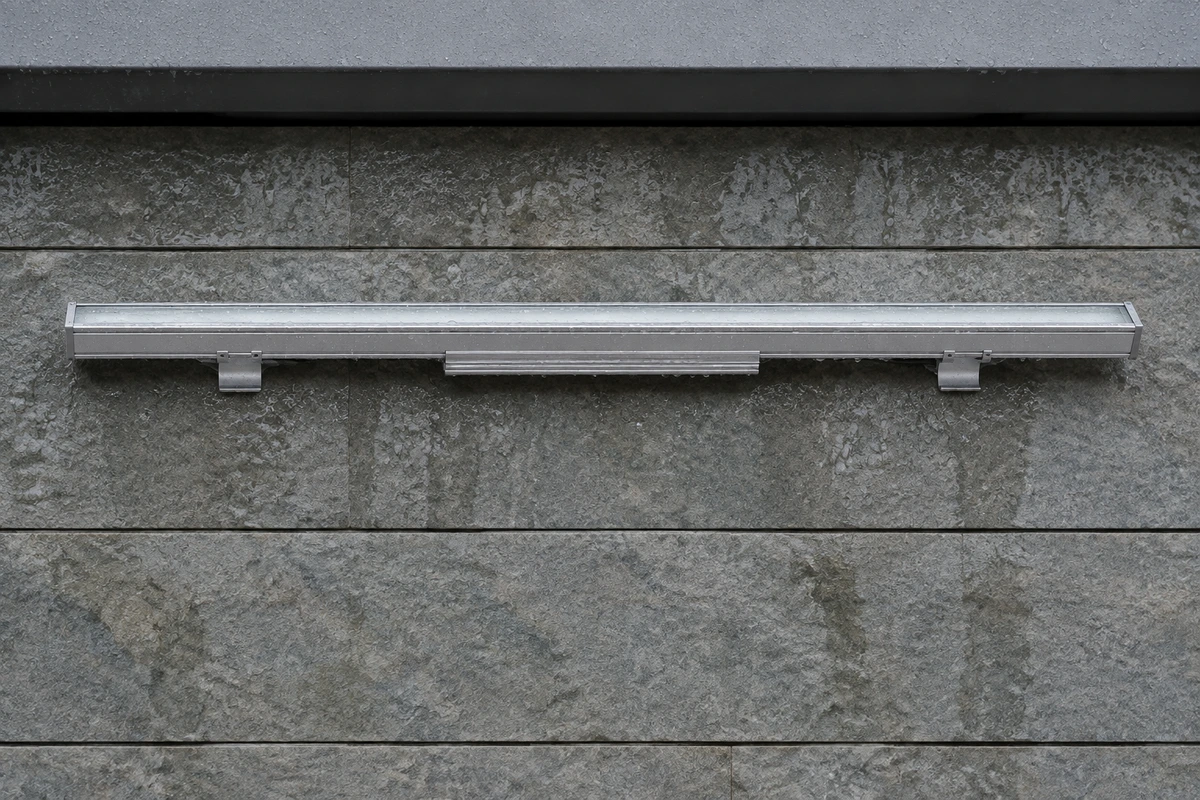
Most condensation is not a manufacturing defect. When the fixture runs, internal air heats and expands. When it shuts off or cold rain hits the housing, the air inside cools fast and the pressure drops, pulling moist air inward through cable entries, gaskets and screw threads. This produces a pumping effect. The moisture condenses on the coldest interior surface, which is usually the inner face of the glass lens. A tempered glass lens on a sealed body, like the one on our 24 W linear wall washer, is exactly where this physics shows first.
Depending on seal quality, an internal vacuum of about -34 mbar (roughly 0.5 psi) is commonly accepted as the point where a sealed enclosure starts leaking at its weak spots, because gaskets and glands relax over time. Once interior relative humidity reaches 100%, condensation forms. A fully sealed enclosure gives the moisture no exit path, so the fog stays on the lens for extended periods.
In instrumented tests, a sealed luminaire cycled about +0.09 psi when switched on and -0.1 psi when switched off. A vented luminaire stayed within about ±0.01 psi across the same cycle. These figures are laboratory measurements.
Matched connectors and a production-line breather
The connector set that ships with our systems is specified at the same IP level as the fixture so the rating holds end to end instead of being silently downgraded at the joint. Our IP67 side-bend neon light ships on the same logic: one sealed system, rated at the joint as well as the body.
A small vent with an expanded PTFE membrane is built into the housing during production. The membrane's pores pass gas molecules and water vapor while blocking liquid water and particles, so pressure equalizes continuously and trapped vapor can escape. We insert this vent while the housing is assembled, not as a later addition.
An open hole or a tortuous path lets dust and insects in. One-way valves vent pressure only outward and do nothing against vacuum. Full potting works but makes electronics unserviceable, so we reserve potting compound for continuously submerged IP68 products like pool and fountain lights.
Gaskets and glands age. UV and heat cycles harden ordinary silicone gaskets, which is why the breathing design matters over the life of the fixture, not just on the day it passes the production test.
Questions that belong in ordinary specification work
A buyer can reasonably ask any supplier whether the IP claim covers the complete assembled configuration, whether external connectors carry the same rating as the fixture, and how the design handles pressure balance over time. These questions form normal specification practice between professionals.
You Might Also Like
-

TL-23XTG-150W Dual-Row Aimable RGBW Flood Light 150 W / 2...
-

TL-12ATG3203-100W Anti-Glare Single-Row Aimable Flood Lig...
-

Outdoor Waterproof Strip Light IP67 12.8W/m DC24V
-

IP65 LED Outdoor Spike Light Spot Light 7W MB18-601
-

BE-WUL0512 In-ground Light 5 W IP67 316 Stainless Steel
-

BE-DUL0801 In-ground Light 8 W IP67 316 Stainless Steel