

Low-Voltage and Mains Power Tracks in Architectural Landscape Spotlights
Nov 02, 2026
Architectural spotlights project targeted accent illumination for building columns, tree canopies, sculptures, and landscape features across exterior environments. Engineering spotlight power tracks splits into two primary electrical configurations: low-voltage direct current (12/24 V DC) tracks and mains direct AC tracks (220–240 V AC) with internal drivers. Mechanical housing forms range from micro-scale compact heads to larger directional spotlight enclosures, utilizing cast aluminium or solid antique brass construction. Product tiers span from micro-scale 1 W spotlights (e.g., BE-SPL0111) designed for low-profile landscape integration up to higher-wattage spotlights such as BE-SPM1801, BE-SPM1001, and BE-SPL0301 engineered for high-lumen structural projection.
Low-Voltage 12/24 V DC Tracks
Low-voltage 12/24 V DC spotlight tracks prioritize electrical safety in accessible ground-level locations. Installed within planting beds, near pedestrian footpaths, or adjacent to water features, extra-low voltage tracks eliminate electric shock hazards if cables are accidentally disturbed during garden maintenance. Centralized remote constant-voltage drivers supply power over two-wire secondary distribution runs, isolating power conversion components from the optical head. Low-voltage spotlight bodies, such as BE-SPL0111 and BE-SPL0301, remain extremely compact, housing only the LED light engine and secondary optics within micro-scale cast aluminium or solid antique brass enclosures.
Secondary circuit length dictates electrical behavior and voltage stability along low-voltage 12/24 V DC distribution lines. Direct current traversing extended copper cable runs encounters inherent electrical conductor resistance, causing progressive line voltage drop between remote power supplies and distant fixtures. Voltage reduction at remote spotlight terminals decreases LED forward drive current and optical lumen output, generating uneven illumination across extended landscape runs. Thicker copper conductor cross-sections or shortened secondary run lengths minimize line resistance, keeping terminal voltage within operational tolerance limits to maintain uniform brightness across connected fixtures. Multi-point feeding layouts, where one driver serves several shorter branches instead of a single long chain, achieve the same result on expansive sites.
Mains 220–240 V AC Tracks with Internal Drivers
Mains voltage 220–240 V AC spotlights, such as BE-SPM1801 and BE-SPM1001, integrate an internal constant-current driver directly within the fixture base or rear housing chamber. Internal driver integration eliminates the need for remote driver enclosures and secondary low-voltage DC cable runs across long landscape distances. Mains-connected spotlights wire directly into standard site AC distribution networks, avoiding line voltage drop limitations on long perimeter circuits. High AC supply voltage operates at significantly lower line current for equivalent wattage, allowing extended power runs across widespread commercial property developments without requiring oversized cable cross-sections.
Internal driver integration modifies thermal dissipation pathways inside mains-connected spotlight bodies compared to remote-driver low-voltage heads. Electrical AC-to-DC power conversion generates internal heat inside the driver module, adding to thermal energy produced by the LED diode array. Cast aluminium housing body mass functions as a conductive heat sink, transferring internal thermal energy outward into surrounding ambient air. Elevated ambient summer temperatures reduce thermal transfer rates between housing metal and surrounding air, elevating internal electronic operating temperatures and triggering internal driver thermal derating mechanisms to protect component electronics.
Beam Optics and Target Geometry
Optical precision in landscape spotlights relies on narrow beam spreads (from 5° spots to 24° medium floods) to translate flat silhouettes into three-dimensional lit volumes. Precision reflector optics and collimating secondary lenses collect wide LED emissions, gathering divergent light rays into tightly controlled beam angles. Narrow 5° spot optics concentrate central candlepower along a tight optical axis, projecting intense illumination over long viewing distances without scattering peripheral light into surrounding dark space. Broader 24° medium flood optics spread output across wider surface areas, illuminating wide building columns, low shrubbery, and architectural facades.
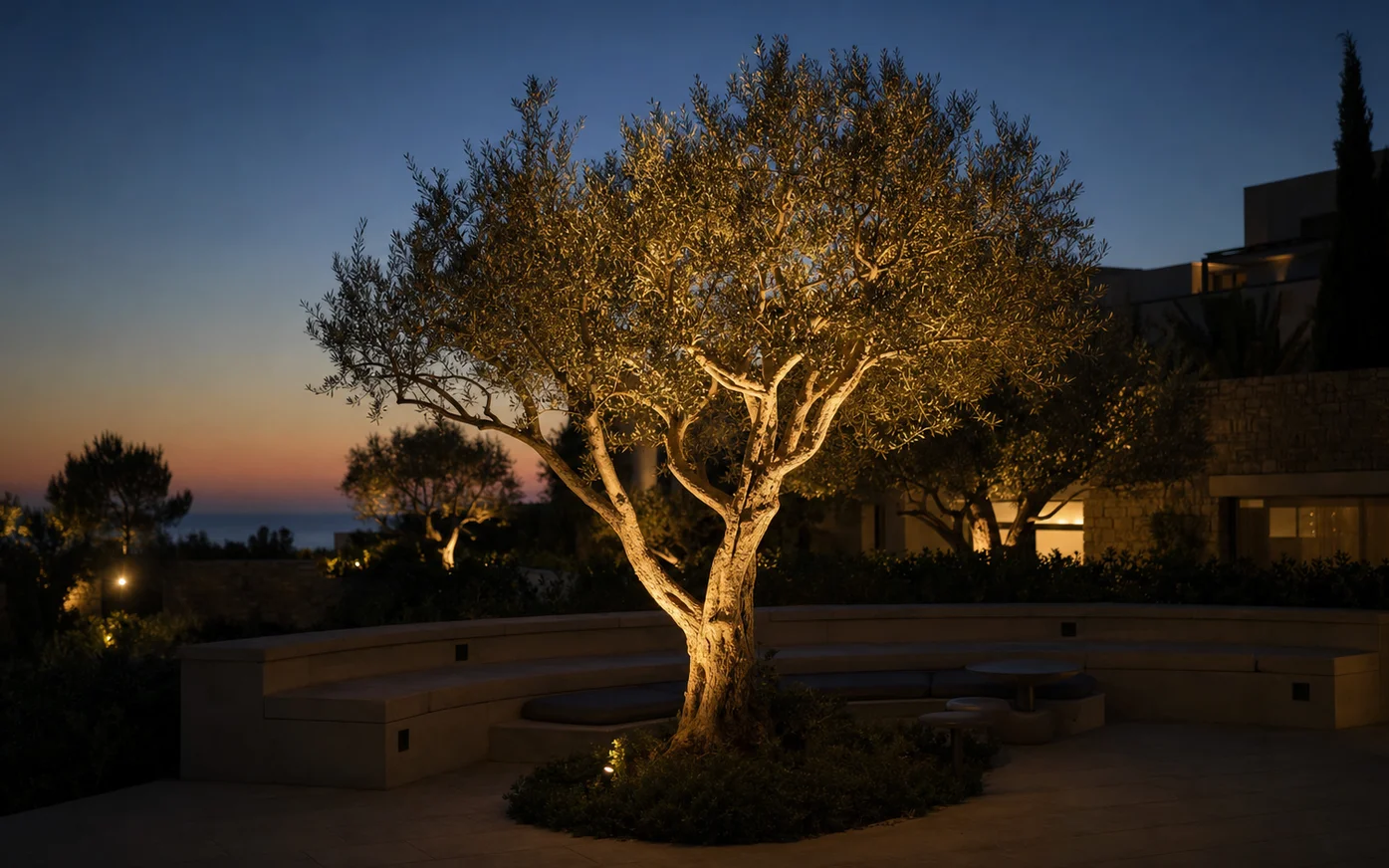
Mounting height, viewing distance, and target physical geometry dictate optical beam selection across architectural features and organic subjects. When illuminating mature trees, a narrow spotlight mounted near the trunk line projects light vertically through the internal branch structure and canopy foliage, rendering the tree as a translucent, textured volume rather than a flat background shape. Tight 5° optical beams reach upper branch crowns on tall mature trees, whereas wider 24° optics cover broad low-hanging branches and horizontal building elevations at shorter viewing distances. Spotlights set back from a facade at grazing angles emphasize surface relief and material texture, while fixtures mounted closer to the same target produce softer, more even coverage.
Salt Exposure and Mechanical Sealing
Environmental site conditions like salt exposure, coastal humidity, and atmospheric pollutants alter metal oxidation rates on exposed spotlight bodies. Atmospheric salt spray deposits corrosive electrolyte films on metal surfaces, accelerating galvanic corrosion on unprotected metal joints. Solid antique brass housing options provide natural atmospheric corrosion resistance, developing a protective surface patina over time in aggressive outdoor environments. Cast aluminium spotlight bodies rely on sealed enclosures to isolate raw metal from moisture, oxygen, and salt air in coastal commercial property installations.
Mechanical seal architecture and ingress protection ratings guard internal optical chambers and electronic assemblies against environmental moisture. Compression gaskets, silicone sealing rings, and waterproof cable glands form physical barriers along housing joints and entry ports. Groundwater accumulation, soil saturation, or temporary surface flooding subjects low-mounted spotlight bases to hydrostatic water pressure. Sealing assemblies resist external fluid pressure, preventing capillary action from drawing moisture along cable strands into housing cavities, which would otherwise induce lens condensation, electrical short circuits, or driver insulation breakdown.
Dimming Protocol Compatibility
Dimming protocol compatibility spans both low-voltage and mains-integrated spotlight families. Micro-scale 1 W spotlights (e.g., BE-SPL0111) and higher-wattage units support DALI, DMX512, 1–10 V, and Phase-Cut (Triac) dimming protocols through compatible driver interfaces, enabling precise scene setting down to low output levels. Digital control protocols like DALI and DMX512 transmit differential data frames over dedicated control wire pairs, maintaining signal integrity across extended cable runs. Analog 1–10 V interfaces adjust output through a dedicated control voltage pair, while Phase-Cut dimming operates through the standard mains supply line where separate control wiring is unavailable in retrofit installations. Variable drive current regulation achieves smooth output dimming transitions across dynamic architectural lighting scenes.
System architecture selection between low-voltage remote driver layouts and mains-integrated spotlight fixtures balances spatial constraints, wiring layout, and target illumination requirements. Low-voltage spotlight bodies suit low viewing distances and ground-level planter beds where compact heads disappear into planting. Mains-connected spotlights, such as BE-SPM1801 and BE-SPM1001, deliver self-contained accent lighting for tall architectural facades and mature canopy structures over long commercial property circuits, providing scalable optical performance across diverse exterior applications.
For landscape spotlight specification files, photometric data or a project quotation, send your site layout and target details through Contact Us.
Background on how we build and test exterior luminaires: About Us.
This guide on low-voltage and mains spotlight tracks was updated in October 2026 for commercial and hospitality exterior projects.
You Might Also Like
-
WAJTS-D114 Garden Spot Light 14 W / 18 W DC 24 V IP66 Alu...
-
55218 Recessed Wall Light 9 W IP65 Die-Cast Aluminum
-

COB Single Color LED Strip 320-528 LEDs/m IP20-IP68 12/24 V
-
4x10 mm Side Emitting LED Neon Flex GM-A2835X-120-X-IPX 1...
-

BE-WUL0312 In-ground Light 2 W IP67 316 Stainless Steel
-

Slim Linear LED Wall Washer TL-XQD-I2401 18-48 W Selectab...