

Aperture Scaling and Mains-Integrated Drivers in Recessed Step Luminaires
Nov 02, 2026
Recessed step and stair luminaires project directional wayfinding illumination across outdoor staircases, retaining walls, and change-of-grade landscape transitions. Architectural step lighting demands precise mechanical integration, balancing optical aperture dimensions against surrounding wall construction, substrate masonry, and civil electrical distribution networks. Product tiering spans from micro-scale marker dots to commercial-grade asymmetric wall step lights. Housing constructions comprise die-cast aluminium bodies with powder-coated finishes, protective tempered front glass, and ingress sealing, supporting both recessed back-box installation and surface-mount wall applications.
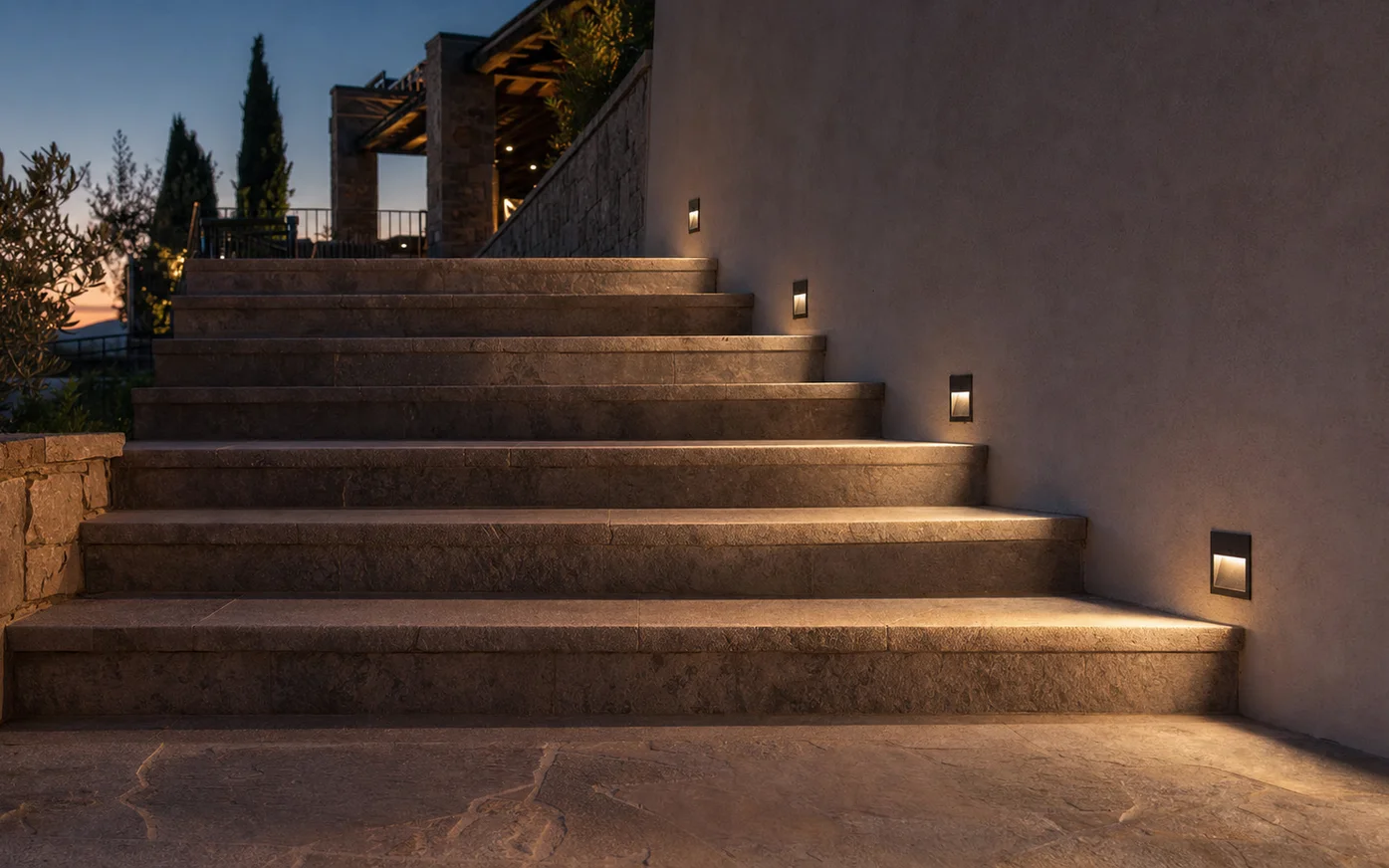
The Aperture Ladder: Micro to Medium
Aperture scaling follows a structured dimensional ladder starting with micro-scale (D16 / D20 mm) circular pin-point markers, such as BE-STL0102. Micro-scale apertures project focused, low-intensity accent dots that delineate individual stair tread edges, vertical risers, and subtle floor transitions without projecting wide glare pools across surrounding surfaces. Compact D16 / D20 mm physical housings install directly into narrow mortar joints between stone paving blocks, timber stair treads, or slim masonry reveals. Small physical aperture volumes preserve structural wall integrity, allowing discrete placement where recessed depth and surface area are severely constrained by structural masonry dimensions.
Medium-scale (D40 / D51 mm) step accent luminaires, such as BE-STL0301, form the mid-tier optical offering for localized pathway pools across private villa stairs, residential garden steps, and boutique terrace landings. Medium D40 / D51 mm apertures house larger optical engines and diffused secondary lenses that expand lateral light spread across horizontal step treads. Secondary optical diffusers widen beam distribution to illuminate adjacent steps from a single luminaire location. Die-cast aluminium housings dissipate thermal energy generated by the internal light engine directly into the surrounding wall cavity, maintaining stable junction temperatures during continuous evening operation.
Large Asymmetric Apertures for Commercial Stairs
Large asymmetric scale apertures (D55 mm and rectangular slots), such as BE-STL0104, BE-STM0301, and BE-STM0401, represent commercial-grade step illumination fixtures engineered for high pedestrian traffic stairways and public retaining walls. Internal forward-throw asymmetric louver optics collect omnidirectional diode emissions and re-orient light downward across wide stair treads. Angled louver blades obscure direct diode viewing lines for approaching pedestrians, preventing upward light spill into pedestrian sightlines while maximizing horizontal tread illumination. Reflector geometry pushes output forward and downward, casting uniform illumination across wide staircases without requiring high mounting elevations above the walking surface.
Mains-Integrated Drivers and Circuit Length
Mains-integrated step luminaires, such as BE-STM0301 and BE-STM0401, incorporate a compact constant-current driver directly within the recessed back-box housing chamber. Operating directly on AC 100–277 V or AC 220–240 V line power, mains-fed step lights eliminate the requirement for remote step-down driver enclosures, secondary power supplies, or external transformer cabinets along public staircases and civic retaining walls. Internal constant-current drivers convert incoming alternating current to regulated direct current within the luminaire base, simplifying multi-luminaire layout architectures by feeding individual fixtures directly from site AC electrical distribution circuits.
Circuit length dynamics change significantly between mains-integrated step lights and low-voltage remote driver systems across long linear stairwell runs. High AC supply voltages (AC 100–277 V or AC 220–240 V) draw lower electrical line current through branch circuit wiring for an equivalent total wattage output. Reduced line current minimizes resistive voltage drop along extended copper cable circuits, allowing continuous daisy-chain wiring across long perimeter walls, multi-flight staircases, and broad commercial property stairways. Low-voltage remote driver configurations traversing equivalent distances suffer from line voltage drop, resulting in light output attenuation at distant luminaires unless secondary conductor cross-sections are significantly enlarged.
Thermal Behavior Inside Wall Cavities
Internal thermal behavior within mains-integrated step light housings depends on heat dissipation mechanisms within confined wall cavities. Alternating-current power conversion inside the internal constant-current driver generates electronic heat, which combines with thermal energy produced by the LED light engine inside the recessed back-box. Thermal conduction transfers heat from internal components through the die-cast aluminium housing mass into surrounding concrete, stone, or masonry wall substrates. High ambient outdoor temperatures reduce the temperature differential between luminaire metal and surrounding wall masonry, slowing thermal transfer rates and causing internal driver electronics to operate at elevated thermal equilibria without sacrificing driver output stability.
Mounting Height, Glare, and Cutoff
Mounting height and viewing distance alter beam geometry, cutoff angles, and light pool coverage across stair treads. Low mounting heights (close to the step tread surface) require steep downward asymmetric throw angles to project light across the entire tread depth without creating harsh shadowing at the riser base. Higher mounting elevations expand lateral beam footprint and extend forward throw distance, but increase potential glare risk if internal louvers do not shield the light source from upper pedestrian viewing angles. Asymmetric louver optics in BE-STL0104, BE-STM0301, and BE-STM0401 fixtures establish sharp visual cutoff angles, maintaining illumination below eye level regardless of stair ascent or descent direction.
Wall cavity depth limitations present severe installation challenges where thin precast concrete panels, solid stone retaining walls, or reinforced concrete structures prevent core drilling for deep recessed back-boxes. Surface-mount step light variants solve spatial constraints by mounting directly onto finished wall faces without requiring back-box recessing into wall substrates. Surface-mount housings feature ultra-slim profiles with angled downward louvers, providing asymmetric light distribution equivalent to recessed fixtures. Outer surface-mount body shells direct light downward through downward-slanted apertures, preventing forward glare while protecting housing profiles against lateral impact forces along narrow pedestrian pathways.
Salt Exposure and IP65 Sealing
Environmental site conditions like atmospheric salt exposure, coastal humidity, and airborne pollutants accelerate chemical corrosion on exposed metal luminaire faces. Direct salt spray deposits sodium chloride crystals on metallic step light fascias, initiating galvanic corrosion along metal edges and fastener joints. Powder-coated finishes over die-cast aluminium housing faces form an inert protective layer, shielding raw aluminium substrate from moisture, oxygen, and salt air in coastal commercial property installations. Non-coated metal components or inferior surface treatments deteriorate under saline conditions, developing surface pitting and finish discoloration that compromise aesthetic appearance and structural integrity over time.
Ingress protection and mechanical sealing guard internal driver electronics and optical assemblies against environmental moisture, cleaning washdowns, and foot traffic impacts. IP65 sealing ratings combine compression gaskets, sealed cable entry glands, and sealed tempered front glass covers to block water ingress from rain, high-pressure cleaning spray, and surface runoff. Physical foot impacts and stray cleaning equipment strike low-mounted step luminaires; tempered front glass lenses and thick die-cast aluminium bezels absorb mechanical kinetic energy, preventing lens fracture and maintaining structural sealing integrity in heavy pedestrian traffic locations.
System selection across the step light product ladder matches aperture scale, optical distribution, and power architecture to site construction parameters. Micro-scale D16 / D20 mm (BE-STL0102) fixtures deliver low-profile accent points within structural masonry joints. Medium-scale D40 / D51 mm (BE-STL0301) fixtures offer balanced accent illumination for private terraces. Large asymmetric D55 mm and rectangular slot luminaires (BE-STL0104, BE-STM0301, BE-STM0401) with mains-integrated drivers operating at AC 100–277 V or AC 220–240 V provide self-contained, high-performance wayfinding illumination across extensive commercial property staircases, combining mechanical durability, IP65 weather resistance, and glare-free asymmetric optical control.
For recessed step light specification files, photometric data or a project quotation, send your stair layout and wall construction details through Contact Us.
Background on how we build and test exterior luminaires: About Us.
This guide on step light apertures and mains-integrated drivers was updated in October 2026 for commercial and hospitality exterior projects.
You Might Also Like
-

GAS10990009-600 Bollard Light 12 W IP65 Stainless Steel
-
10x10 mm Three Sides Emitting LED Neon Flex GM-A2835Y-120...
-

BE-WUL0512 In-ground Light 5 W IP67 316 Stainless Steel
-
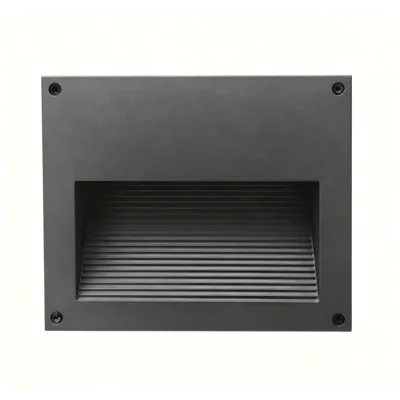
53188 Recessed Wall Light 8 W IP65 Die-Cast Aluminum
-
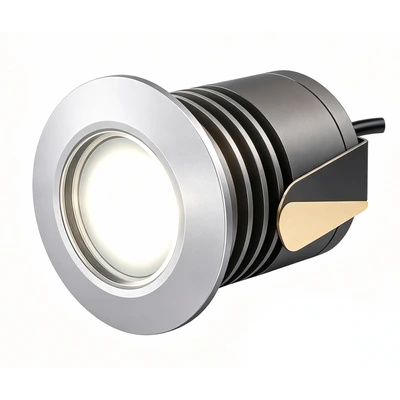
BE-STL0101 Step Light 1 W IP65 Aluminium
-

BE-SPL0101 Spot Light 1 W IP65 Aluminium